

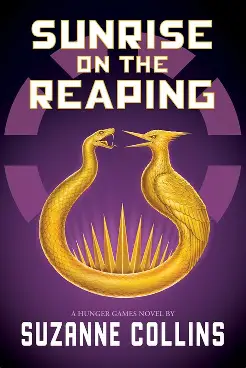
“ I love you like all-fire.” (Suzanne Collins, The Sunrise on the Reaping)
Sunrise on the Reaping by Suzanne Collins follows Haymitch Abernathy, a sixteen-year-old from District 12 of Panem, a futuristic and dystopian world, as he is forced to compete in the 50th annual Hunger Games. A much-anticipated prequel to the bestselling Hunger Games series, this novel expands upon the stories of several favorite characters introduced in the trilogy as well as those of a stunning new cast. Sunrise on the Reaping, a gripping story about love, loss, and rebellion, has rightfully earned its place in the legendary world of Panem.
Summary:
Fans of the original Hunger Games series already know Haymitch Abernathy, the sardonic victor of the 50th Hunger Games who acts as Katniss’s mentor in the first novel. While hints are dropped about Haymitch’s past in the original trilogy, Sunrise on the Reaping dives deeper and, through a first-person perspective, tells the story of Haymitch’s Games and their aftermath.
Review:
As a huge fan of both the original Hunger Games series and the 2020 prequel, The Ballad of Songbirds and Snakes, I was REALLY excited about Sunrise on the Reaping. Like, counting-down-days-excited. Fortunately, Suzanne Collins didn’t disappoint with this absolutely stellar prequel.
One of my favorite things about the entire Hunger Games franchise is Collins’s narrative voice. The way she writes feels extremely grounded in the harsh world of Panem rather than being overdramatic or flowery. I also appreciated Collins’s use of a first-person point of view, which made Haymitch’s story feel more real and personal. It also made Sunrise on the Reaping feel more similar to the original trilogy after The Ballad of Songbirds and Snakes, which was written in a limited third-person point of view. Haymitch’s internal monologue also sounded a lot like Katniss’s, which contributed to the many parallels and allusions to the original series. I also loved how Collins wove in one of my favorite poems, The Raven by Edgar Allen Poe, as an ancient piece of writing that Haymitch uses to reflect on his feelings for his girlfriend, Lenore Dove, and his struggle with the possibility that he may never see her again after being reaped to participate in the Hunger Games, an annual televised fight to the death.
In terms of Haymitch and his development, Sunrise on the Reaping was an excellent character study. The first-person narration pulled me into the story and made Haymitch feel like a very realistic and relatable character that you have no choice but to empathize with and root for. This makes it all the more tragic as the novel continues, and it becomes easy for the reader to see how rebellious and spirited teenager Haymich has become the cynical, alcoholic, yet still defiant victor that Katniss meets at the start of her own story. Aside from Haymitch, Sunrise includes several other characters who are present in the main trilogy. Needless to say, this excited me (and many other fans) to no end since a lot of the characters who made surprise appearances in Sunrise on the Reaping were intriguing yet largely unexplored by the first three novels. After reading the Hunger Games trilogy, I felt like there was so much more that could be said about these interesting side characters, so it was very gratifying that those needs were fulfilled by the Hunger Games’ latest installment in a way that was thoughtful and made sense plot-wise.
Sunrise on the Reaping explores similar themes to the original Hunger Games trilogy, including the weight of rebellion, loss and grief, the power of love to build or destroy, and the strength of hope to unite the oppressed. Instead of feeling too forced or being examined through long inner monologues, these themes fit naturally into the action-packed story.
As I mentioned earlier, one of my favorite plot devices in Sunrise on the Reaping was Collins’s use of The Raven. We had seen some of this in the earlier prequel, The Ballad of Songbirds and Snakes, as old rhymes and songs were woven into the story as old District 12 tunes or Covey folklore. I felt like this added so much depth to Panem, making it seem less of an unrealistic, dystopian universe. By adding these snippets of poetry and song, Collins reminds us that Panem was once modern-day America, and because of this connection, seeing such a well-known Edgar Allan Poe poem in the Hunger Games made reading both a familiar and slightly unsettling experience in all the best ways.
Since I’m a huge Hunger Games fan, my favorite parts of Sunrise on the Reaping were definitely the connections to the other books in the series, especially the shared songs and the characters whom we got to learn more about. I’m also absolutely obsessed with the epilogue– I’ll just leave it at that.
While some critics accuse Sunrise of being too catered to fans, I believe that Collins did a great job at balancing allusions and easter eggs to the other books and keeping her writing thought-provoking, fresh, and memorable. There are more similarities to The Hunger Games than to The Ballad of Songbirds and Snakes, but it didn’t feel as if Collins was trying to reuse too many elements of the first book. Instead, the writing is just similar enough to feel like you’re in the world of Katniss’s Panem. This was something I had missed when I was reading Ballad because of its setting, some 60 years or so before Katniss’s Games, when the Games were just developing. Its use of third-person point of view narration by Coriolanus Snow, a mentor of one of the tributes and the villain of the original trilogy, makes it feel less personal than the previous books. However, Sunrise on the Reaping, which takes place only 24 years before Katniss’s story and is narrated by a tribute, brings readers back to that place of first-hand terror and adrenaline that thrilled millions into becoming fans of the series in the first place.
There were honestly very few, if any, elements of this book that I was unhappy about. If anything, I was upset that the story was too good. While I’m not going to spoil anything, I will say that Sunrise tricked me into thinking that maybe– just maybe– Collins would give Haymitch a happy ending, one different from what was written in the original series. . . and I was definitely mistaken. Sunrise was devastating and will wreck you emotionally.
Overall, Suzanne Collins’s Hunger Games novel, Sunrise on the Reaping, was an absolute bombshell of a prequel. Cleverly set between The Ballad of Songbirds and Snakes and The Hunger Games, it makes evident the impact of the events of Ballad on the world of Panem while maintaining an obvious connection to the original trilogy with its depiction of the evolving structure of the Games themselves, the state of the rebellion, and several familiar and beloved characters. Not only does Sunrise on the Reaping tell an unforgettable story of resistance and resilience– at its heart are the beautiful and heartbreaking relationships between Haymitch and his loved ones, honoring and contributing to the Hunger Games series’ exploration of love, loss, and hope. As Suzanne Collins notes in her acknowledgments section of Sunrise on the Reaping, “The snow may fall, but the sun also rises.”
I would recommend reading Suzanne Collins’s original Hunger Games trilogy– that is: The Hunger Games, Catching Fire, and Mockingjay– plus the prequel, The Ballad of Songbirds and Snakes, before picking up Sunrise on the Reaping. While you could also read the books in chronological order (Ballad first, then Sunrise, then the original trilogy), I wouldn’t recommend it as both Sunrise and Ballad contain many allusions to the original series– and Sunrise contains even more references and connections to both the original trilogy and Ballad. The original trilogy also provides a more detailed explanation of Panem and the Games, worldbuilding details that would help you better understand the prequels.
As for other dystopian series for Hunger Games fans, I recommend the Divergent series by Veronica Roth, which contains similar themes of resistance and individual v.s. society conflict while maintaining a quick pace and weaving in both action and romance.
I would give this book: 📚📚📚📚📚 – an outstanding addition to the world-famous Hunger Games franchise! (5/5- I would give it 6/5 if I could!)
Happy Reading – and may the odds be ever in your favor!
Love, Lili
GFB Ambassador