

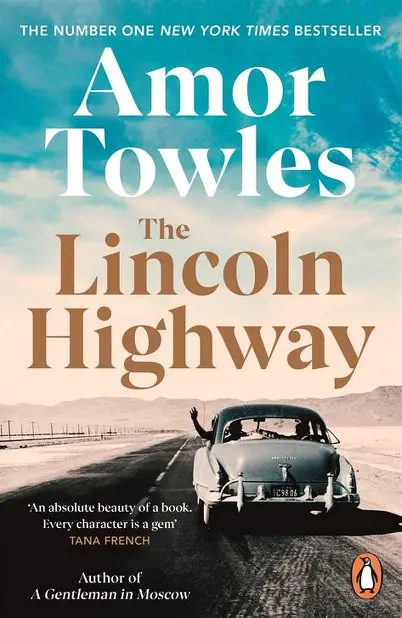
“Well, that’s life in a nutshell, ain’t it. Lovin’ to go one place and havin’ to go another” (Towles 151).
Summary;
This novel follows a ten-day venture of a young adult who has recently been released from a juvenile work farm, along with his younger brother and two of his friends from the farm. Emmet, the protagonist, is an optimistic, charming, but restless 18 year old whose impulsiveness landed him at Salina, where he was let off early for good behaviour after spending 15 months making laborious amends for unintentional homicide. His younger brother, Billy, shares his idealistic character and is extremely bright for his young age. The boys’ father having just passed, both Emmet and Billy decide to make a new life away from their small midwestern town, a journey which is interrupted by Duchess and Wooly, Emmet’s comrades at Salina. These two characters have curated a plan which in theory would provide a stronger foundation for their friends’ big ambitions of starting over, but instead proves to be an obstacle full of new places, people and connections.
Review:
The Lincoln Highway is a good example of Towles’ profound ability to connect a reader with his complex characters and immerse you in scenes and relationships rich with detail that make one feel as though they are witnessing it themselves.
This book in particular is difficult to get bored of because of the diversity of the chapters. As is seen in Towles’ first novel, Rules of Civility, focus on each character shifts every chapter, keeping the reader’s attention with multiple styles and temperaments of narrative. In fact, to add more storytelling variety, the author writes some characters, like Duchess and Sally, from the first person, while others, like Emmet and Wooly, from the third person. I believe this pulls the reader closer to the characters because it’s as if those first person chapters are arguing for themselves; as if those characters are attempting to sway the reader to their side of the story.
The titles of the novel’s sections are a large part of what makes it so captivating; instead of labeling the days one through ten, Towles chooses to count down, making each turn of a page more compelling than the last. I also think that the adventures in the book being seen by the protagonist as unnecessary detours taking time and efficiency away from his end goal of a new life add a beautiful layer of tension that urges the reader to keep moving forward (if only for Emmet’s sake!).
The themes of optimism and determination in The Lincoln Tunnel were clear to me through Emmet and Billy’s drive to continue onward to a better future, and their ability to work through setbacks ignited by those around them with differing priorities. The dynamic between Duchess and Emmet is an example of this gap in objectives, and also highlights the element of greed versus principalism evident throughout this book.
Another component in this novel that I find to be unique to Towles is the depth of his descriptions of characters or texts that are not the backbone of the novel, necessarily. I believe he chooses to add so much detail to the backgrounds of and interactions with these elements because though they may not be central to the plot or relevant to all parts of the story, they make large impacts on the evolutions of certain characters. In The Lincoln Highway, this is displayed in the case of Ulysses or Professor Abernathe’s book.
Overall, I think this book is interactive, witty, and a lovely representation of Towle’s style, which I am rather partial to. However, despite how sure I am that it would captivate a large amount of audiences, it is not my favorite of Towles’. I think my preference for his other novels comes from the fact that I’m simply more familiar with the types of lives led by the characters in his other books. That is to say, this preference may not at all be relevant to many people.
Love, Frances
GFB Ambassador